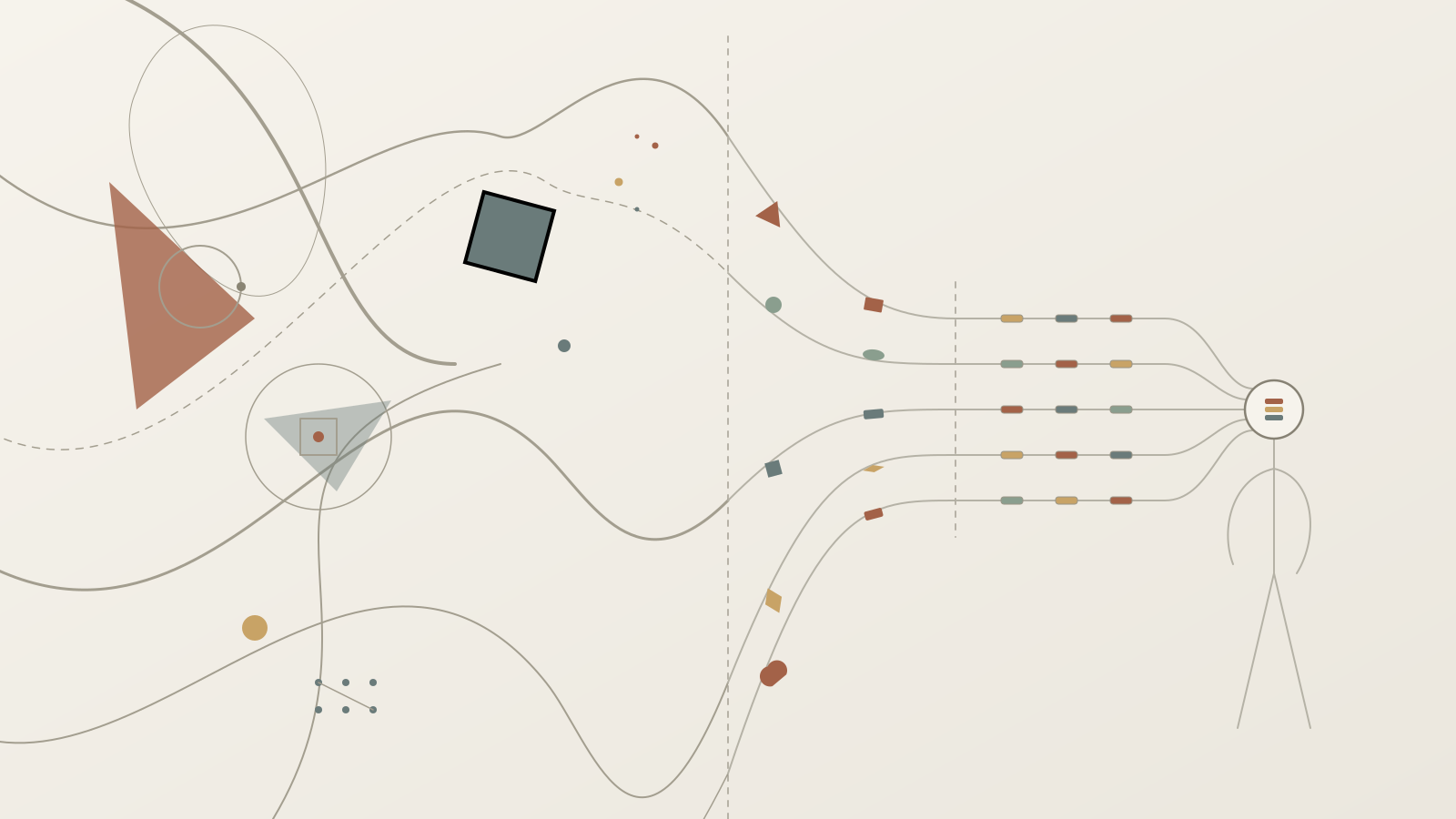
There is a specific kind of dissatisfaction that only happens in the presence of abundance.
You open a platform, scroll through more than you could ever consume, and find nothing that catches. Not because the quality is bad. Because everything feels like something you have already had. You close the tab. You open another one.
This is not boredom. Boredom is a problem of scarcity. What you are feeling is something closer to a narrowing: the walls of what seems possible to want moving quietly inward, without your noticing when it started.
If this were only a personal mood, it would not be worth writing about. But the feeling has company, and you can see its shape in places that have nothing to do with screens.
In music and writing, the friction of originality has given way to the ease of recombination. What used to feel like a genuine departure now often feels like a variation on a known template. A 2024 study found measurable evidence of this: people using AI tools for creative work produce outputs that are more semantically similar to each other than those who do not. The homogenization does not arrive all at once. It accumulates. Research on music streaming has documented how artists consciously reshape their work to fit what algorithms reward, favoring familiar structures over genuine departures. The result is not censorship but a steady narrowing of what gets made and what gets heard.
Cities tell the same story in physical space. A 2020 study assessing 194 cities found a global trend toward homogeneous urban form, independent of size or geography. Parallel research across China, India, and the United States confirmed the same convergence. Urban planners warn that when standardized models are applied without regard for local context, they overwrite what Jin Duan calls “space genes”: the stable patterns formed over generations through the interaction of a place, its people, and its particular history. Cities built under the same economic pressures, shaped by the same reference images, increasingly look as if they were imagined by the same small group of people.
The clearest evidence comes from the one field built entirely around fighting this tendency. Strategic foresight exists precisely because groups asked to imagine the future without structure tend to reach for the same small set of shapes. Jim Dator, a pioneer in scenario planning, documented that most futures imaginings collapse into four categories regardless of who is in the room: growth, collapse, discipline, and transformation. A 2025 study found the same four shapes recurring across different groups, contexts, and prompts. The entire architecture of foresight practice, scenario mapping, horizon scanning, uncertainty mapping, exists as a counter-pressure against this gravitational pull. That a discipline has developed specifically to expand what groups can imagine is not evidence that imagination is fine. It is evidence that the narrowing is strong enough to require a professional practice built around resisting it.
None of these domains share obvious causes. The narrowing appearing in all three is either a remarkable coincidence or a signal worth following.
Here is what it points to.
Imagination is not a fixed capacity. Like most cognitive processes, it depends on its inputs: exposure to difference, contact with the unfamiliar, the friction of encountering things that do not simply reflect back what you already know. Research on creative cognition has found that genuinely new thinking depends on the prepared mind meeting something it did not anticipate, the moment when the external world intrudes on internal processes in a way that cannot be managed in advance. A 2022 study published in Frontiers in Psychiatry found that exposure to environments with greater diversity improves not just the quantity but the originality of ideas. The range of what you can imagine is directly related to the range of what has genuinely surprised you.
Which means the quiet feeling of flatness from the opening is not a personal failure. It is what happens when the environments managing your inputs have been optimized to reduce surprise. Not deliberately. As an inevitable consequence of systems built to maximize engagement, which turns out to mean: more of what you have already responded to, and less of what you have not yet encountered. Eli Pariser described the endpoint of this logic plainly: a world constructed from the familiar is a world in which there is nothing to learn. What follows from that is that a world with nothing to learn is a world with increasingly less to imagine.
You go back to the feed. The recommendations are accurate, the content is abundant, and the space of what seems possible has quietly contracted. Not through any deliberate decision. Through the cumulative logic of systems designed to give you exactly what you already know.
That is the condition this series is built around. The next piece asks what it looks like when that condition scales: if imagination depends on inputs, and those inputs are changing, what does depletion actually look like from the inside?
References
Nguyen, C. et al. (2014). Exploring the filter bubble: The effect of using recommender systems on content diversity. ACM WWW Conference Proceedings. https://dl.acm.org/doi/10.1145/2566486.2568012
Ross, W. (2024). Accidental Thinking: A Model of Serendipity’s Cognitive Processes. Journal of Creativity, SAGE. https://journals.sagepub.com/doi/10.1177/10892680241254759
Lemoine-Rodriguez, R. et al. (2020). The global homogenization of urban form: An assessment of 194 cities across time. Landscape and Urban Planning. https://www.sciencedirect.com/science/article/abs/pii/S0169204620306137
Boone, C. et al. (2022). Are global cities homogenizing? An assessment of urban form and heat island implications. Urban Climate. https://www.sciencedirect.com/science/article/abs/pii/S0264275122001445
Duan, J. (2022). How do we stop the homogenization of cities? Nature. https://www.nature.com/articles/d42473-022-00370-0
Bommasani, R. et al. (2024). Homogenization Effects of Large Language Models on Human Creative Ideation. arXiv. https://arxiv.org/pdf/2402.01536
Magaudda, P. (2021). The algorithmic imaginary of cultural producers: Towards platform-optimized music? H-ermes Journal of Communication. https://apeiron.iulm.it/retrieve/a096a271-54e1-4a19-80a5-5004e76e3390/(2021)%20H-ermes%20-%20Algorithmic%20Imaginaries.pdf
Dator, J. (2009). Alternative futures at the Manoa School. Summarized in: Four scenarios to imagine the future. IESE Insight. https://www.iese.edu/insight/articles/future-scenarios-imagine/
Soini, K. et al. (2025). Experimenting with dystopian scenarios and imagined futures in Environmental and Sustainability Education. Environmental Education Research. https://www.tandfonline.com/doi/full/10.1080/13504622.2025.2588269
Liu, J. et al. (2022). The influence of natural environments on creativity. Frontiers in Psychiatry. https://pmc.ncbi.nlm.nih.gov/articles/PMC9363772/
Pariser, E. (2011). The Filter Bubble: What the Internet Is Hiding from You. Penguin. https://dl.acm.org/doi/10.5555/2361740