
Urban Planning / Civic · Strategic Foresight · 2023–2025
Downsview Redevelopment: Applied foresight for long-horizon urban planning
Led scenario planning and trend synthesis for a major urban redevelopment project in Toronto, in partnership with Northcrest Developments. Produced 28 trend cards and 20 scenario worlds across five axes of uncertainty, with research anchored in the complete communities planning framework.
Overview
The complete community is an established planning concept with significant foundational research behind it: a neighbourhood that provides residents with equitable access to housing, services, mobility, and public life across their lifetimes. What this project set out to explore was how foresight methods could make that concept more practically useful, by testing what a complete community needs to hold up under a range of future conditions rather than a single projected one. Downsview (YZD), one of the largest urban redevelopment projects in Canada, was the live context for that exploration. Northcrest Developments partnered with the Visual Analytics Lab at OCAD University to embed strategic foresight into the planning process.

The YZD site: a former military base in Toronto being redeveloped into a mixed-use district at significant scale.
The question
This section reflects the framing I helped develop as part of the research team. The shift from "what will happen" to "what should we be resilient to" was a deliberate methodological choice made collectively.
The complete community framework has well-established dimensions: housing diversity, mobility access, employment proximity, public space, health infrastructure, and community services. The research team adapted this framework to the YZD context and asked a different question of it: which dimensions are most exposed to long-horizon uncertainty, and how should planning account for futures where current assumptions no longer hold? Foresight does not replace the complete community framework. It stress-tests it against conditions that planning documents cannot easily anticipate.
Northcrest had published a Responsible Development Framework outlining principles for how the project should proceed. The research task was to evaluate that framework against emerging trends and plausible futures, surfacing the conditions it was most and least prepared for.

The Responsible Development Framework: the lens against which trends and scenarios were evaluated.

The YZD Framework Plan: seven districts, a 2km reimagined runway, and a network of open spaces planned over multiple decades.
Environmental scanning
Signal scanning was a team effort across the three student researchers. I was a core contributor, scanning academic, policy, and professional sources. Synthesis and prioritization of trends into the final 28 involved refinements I led, particularly in the technology, economic, and values domains.
We used the STEEPV+C framework to structure the scan across seven domains: Social, Technological, Economic, Environmental, Political, Values, and Cultural. Scanning drew from academic literature, policy documents, professional publications, news sources, and Northcrest consultation materials.
Over 100 signals were identified, mapped, and assessed for relevance and impact. The mapping exercise made patterns visible: which domains were producing the most active signals, where tensions between domains were emerging, and which trends were likely to compound each other over time.

STEEPV+C signal mapping: 100+ signals distributed and weighted across Social, Technological, Economic, Environmental, Political, Values, and Cultural domains.
Trend synthesis
The refinement of trends into the final 28 cards was work I led substantially, particularly in the later drafts. Alignment of each trend against the Responsible Development Framework was a collaborative synthesis exercise with the full research team.
From 100+ signals, the team synthesized 28 key trends. Each trend was developed into a structured card covering: the emerging trend, the opportunity it presented, and supportive strategies for the development to consider. The 28 trends were then mapped against the Responsible Development Framework to identify which principles were most supported by current conditions and which faced the most uncertainty.
Trends were organized into thematic groups for the workshop: urbanization and housing, health and community resilience, social and demographic shifts, technology and workforce, and environmental sustainability. This grouping made the volume of material manageable for client engagement without losing the structural analysis underneath.

Sample trend card: each card covers the emerging trend, the opportunity it creates, and strategies for the development to consider.

Trends mapped against the Responsible Development Framework to identify alignment, gaps, and areas of uncertainty.
Workshop
I created the workshop materials including the trend card groupings and stress-testing prompts. The workshop preceded the scenario planning exercise. Findings from the stress-testing session directly informed the axis pairs and world framings. The session was led by faculty; I co-facilitated one of the four trend groups.
We delivered a one-hour foresight workshop to the Northcrest and Hines teams. The session was structured around strategy stress-testing rather than passive presentation: participants were split into small groups, each given a set of trend cards, and asked to evaluate the strategies against their own knowledge of the development context.
The questions put to each group were: how might these trends impact YZD? Are the strategies viable, and if not, what would you change? What trends concern you most that the research should explore further?

Sample trend group cards presented to participants: each group covered three related trends with descriptions and strategies for stress-testing.
Scenario planning
I initiated the scenario planning exercise following the workshop, using the priorities and gaps surfaced by the Northcrest team as input. The axis pairs and individual world scenarios were primarily my work. Faculty reviewed and contributed to the narrative descriptions.
Trends alone describe what might happen. Scenarios describe the conditions under which multiple trends interact and amplify or counteract each other. The 2x2 matrix method takes two axes of uncertainty, each with two extreme poles, and generates four distinct world scenarios in the quadrant space between them.
I developed five axis pairs, each exploring a different dimension of uncertainty relevant to the development. Each pair generated four worlds, producing 20 scenario worlds in total. The axis pairs were: socioeconomic distribution vs. climate adaptation; cultural cohesion vs. economic growth model; urban expansion model vs. policy approach; workforce stability vs. automation integration; and governance structure vs. policy intervention.
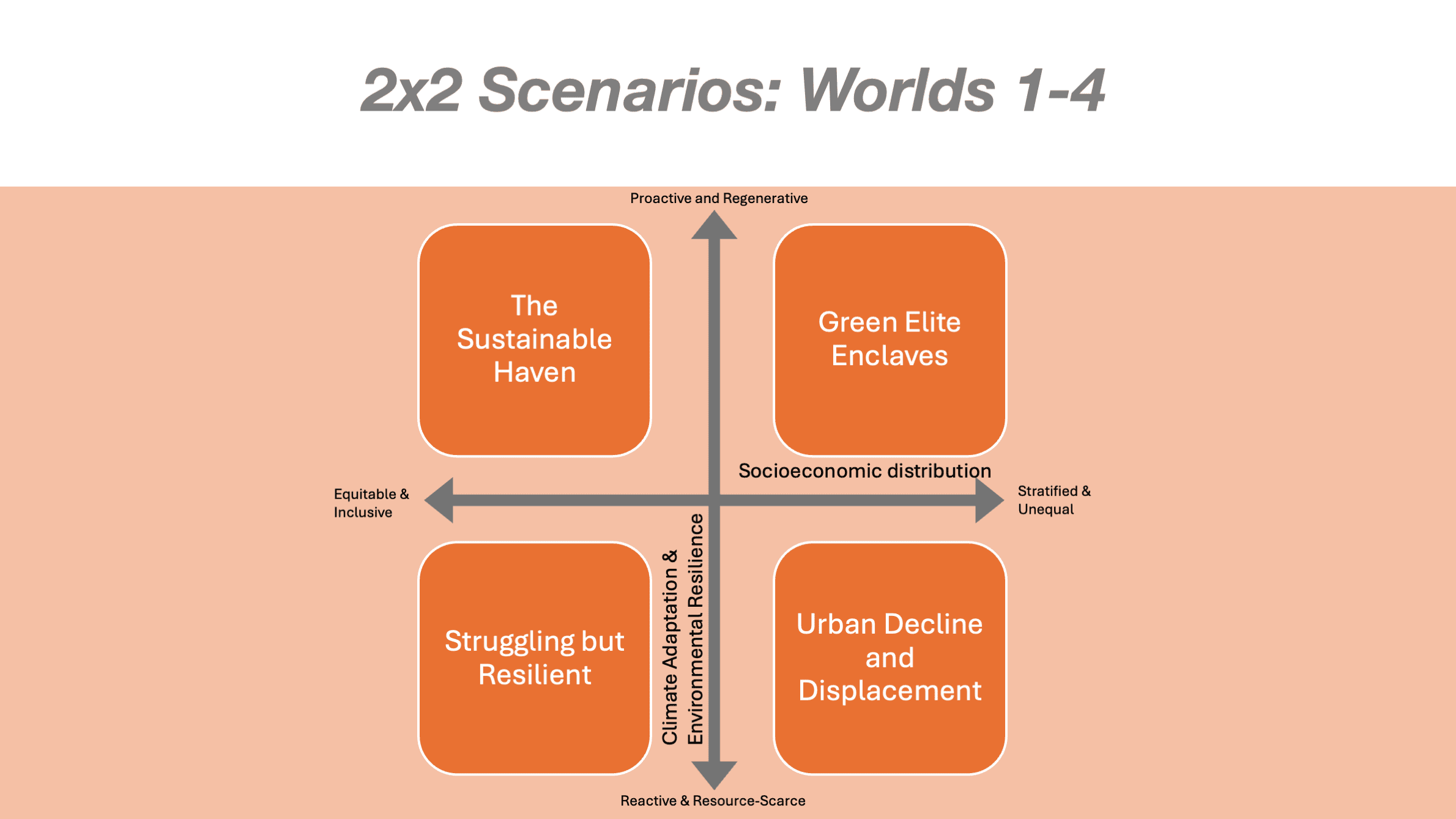
Sample 2x2 scenario matrix: four worlds emerging from two axes of uncertainty, each representing a distinct future condition for the development to plan against.

Sample world scenario: each world was developed with a name, a plausibility assessment, and implications for the development planning priorities.
The scenario naming was deliberate. Names like "Green Elite Enclaves," "Tech-Driven Precarity," and "Urban Decline and Displacement" were chosen to be memorable and specific enough that the client team could immediately grasp the character of each world without reading a full description. This made the scenarios usable as shared reference points in planning discussions.
From scenarios to strategy
This section reflects the full team collaborative synthesis. My contribution was in the scenario framing that underpinned the recommendations, and in the writing and editing of several strategy areas.
The 20 scenario worlds were not the final deliverable. The report used them as lenses to derive concrete planning recommendations for the Hangar District, the first phase of the YZD redevelopment. Each recommendation was grounded in which scenario conditions made it necessary and which trends made it urgent.
Ten planning themes were addressed: long-term adaptability, climate responsiveness, technology infrastructure, arts and culture, social cohesion, community engagement, health infrastructure, lifelong learning, local economic development, and diversity and inclusion. Each theme was approached as a planning question: what conditions does the development need to hold up under, and what does that require at the planning stage?
The most cross-cutting finding was adaptability. Across all five scenario axes, the developments most likely to succeed were those designed for change rather than optimized for a single predicted future. That translated into concrete recommendations: flexible zoning, modular building design, governance models that could evolve, and tenant selection aligned with long-term community goals.
The work concluded with a coverage assessment mapping how well the current YZD plans addressed each dimension of the complete community framework as redefined for this context. Each dimension was rated against the evidence in the planning documents, producing a clear picture of which areas were well-developed, which had partial coverage, and where future phases of the development would need to focus.

Sample coverage radar: each spoke represents a complete community dimension, rated against current YZD planning documents to identify strengths and gaps.
Reflection
The most useful thing the foresight process produced was not the scenarios themselves but the structure of uncertainty they made visible. The Northcrest planning team already had intuitions about risk. What the research gave them was a framework for distinguishing between conditions they could plan for, conditions they needed to monitor, and conditions that required fundamentally different responses.
The scenario work also clarified something about the limits of planning at long horizons. No single scenario will be right. The value of the exercise is in stress-testing decisions against a range of plausible conditions before committing to them. A development that holds up across all 20 worlds is more resilient than one optimized for the most likely future.
Good long-horizon planning is not about predicting the future. It is about building something that does not depend on one version of it being right.